

Not a Medium member? Read this article for free here.
As a Doctor of Psychology and a neuroscientist, I love observing people's behavior through my expert lens. And many behaviors that are accepted as "normal" or "common" don't align with how your brain works best.
Here are 10 things I consciously avoid and what I do instead, backed by science (and yes, I've engaged in many of them myself in the past). You might spot behaviors you also engage in, and hopefully get some inspiration on how to replace them.
1. Check my phone first thing in the morning.
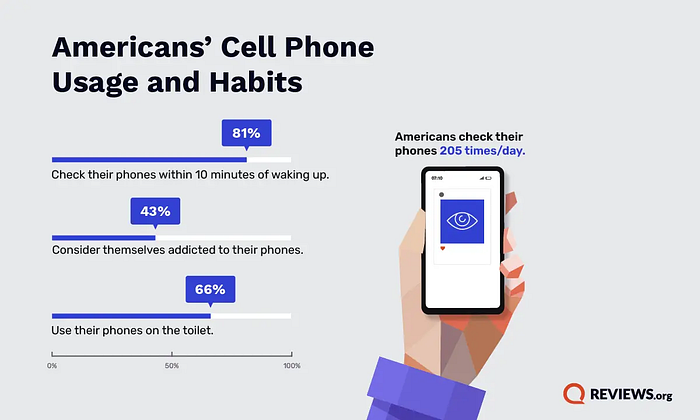
81% of people wake up and immediately grab their phones. Are you one of them?
What I do instead:
I don't keep my phone on my nightstand. My alarm clock is an old cellphone that doesn't have a SIM card or an internet connection. And if it ever stops working, I'll buy an alarm clock to avoid having my phone on my nightstand.
I wake up thinking about what I'm grateful for, and I also immediately drink roughly 300 ml of lukewarm water to hydrate after 8+ hours without any liquid intake.
What science says:
The first 60–90 minutes after waking set your tone for the day. Your body also produces most of its cortisol in the morning, especially during the first 30–45 minutes after waking. It's called the cortisol awakening response.
This response is a good thing because it activates you, but if you expose yourself to notifications, negativity, and work stress immediately, you'll spike your cortisol response and start your day in a high-stress mode.
Instead, replace it with gratitude: A regular gratitude practice improves mental and physical health. And don't forget to hydrate: Even slight dehydration can affect your mood and cognitive function, so be sure to start the day with some hydration.
2. Sleep less to have more time for other things
Intuitively, it sounds good: "Waste" less time doing nothing (a.k.a. sleeping) to have more time for the "important" tasks. But it doesn't work.
What I do instead:
I make sleep a top priority. I aim for eight hours of quality sleep every night, maintaining a consistent bedtime schedule, blocking out light with a sleep mask, reducing noise with earplugs, and keeping my bedroom cool.
What science says:
Dr. Matthew Walker, a world-famous sleep scientist, puts it this way:
"Sleep is the single most effective thing we can do to reset our brain and body health each day."
Sleep deprivation leads to a "set of disruptions in human behaviour across nearly all domains of cognition and affect", according to a review in Nature Reviews Neuroscience. It's also linked to an increased risk of cardiovascular disease, diabetes, obesity, depression, and dementia.
Sleep is vital for any function you can think of:
- Memory
- Reaction times
- Appetite control
- Decision-making
- Emotion regulation
- Immune system function
- Cleaning out toxic proteins
Lost sleep leads to lost productivity and many other problems.
3. Be overconfident about what I remember.
Many people assume that their memory is like a video camera that records everything, so to remember something, you just scroll back through the video and there it is: your memory of situation X.
What I do instead:
My memory is very good, but as a neuroscientist, I also know that memory is a construction and that memories from the past underlie this construction process as well. I try not to be too confident in what I remember, take notes on important things, and verify key information.
What science says:
Memory is constantly "under construction", and even past memories aren't permanent. There's a process called reconsolidation, which means that every time you think about something that happened in the past, your memory of it becomes malleable and can change.
Maybe you have a story that always comes up at family gatherings? Monitor how people discuss it, and you'll notice how it transforms over time.
Another example is false memories: Evidence shows that we remember things that were never there. For example, if you read a story about a restaurant visit and try to remember it later, you'll likely add details that weren't mentioned but that fit your idea of what a restaurant visit usually looks like.
Flashbulb memories are a fascinating phenomenon, too: They occur for highly disruptive emotional events such as 9/11. Research that surveyed people right after the event and then followed them up over several months showed how their stories about where they were and how they first learned about the event changed over time. And yet, people remained highly confident about their memories. High confidence doesn't guarantee accuracy.
4. Stay seated at my desk when I'm stuck
It's common for people to say, "I won't move until I solve this problem,"/"I'll stay on my desk until inspiration strikes," or similar. Be aware: Inspiration is unlikely to strike if you stay 'on task'.
What I do instead:
I do something else: I go for a walk, take a shower, or prepare a meal for later. When you're stuck, moving away is the best thing you can do to move forward.
What science says:
Your brain benefits from being 'idle' a status that activates your default mode network and helps you come up with new ideas.
One go-to activity whenever you're stuck is a walk: In a study where participants were asked to come up with unconventional uses for everyday objects, the group that walked outside generated more ideas than the group that remained seated.
5. Treat nutrition as separate from brain health.
When I was a Psychology student about 20 years ago, nobody talked about how nutrition influences the brain. But fortunately, this tendency is slowly changing.
What I do instead:
I follow a brain-supportive diet, which includes whole foods, a variety of vegetables, healthy fats (such as nuts, fish, and olive oil), and fermented foods, while limiting ultra-processed foods and sugar. I also focus on staying hydrated and on maintaining a healthy information diet because the information you consume also shapes you.
What science says:
One key aspect is the gut-brain connection: Today, we know that the gut and the brain are tightly linked and communicate bidirectionally (i.e., your gut sends signals to your brain and vice versa). The gut influences the brain in different ways, for example, through the modulation of neurotransmitter activity and of the stress response.
There are also promising results on the effects of nutrition interventions on mental health, such as this study, which shows improvements in depressive symptoms with a modified Mediterranean diet.
6. Keep my phone in sight when I'm trying to focus.
Smartphones have become an essential element of most people's lives, and I am no exception. But just having it in sight kills your focus.
What I do instead:
I keep my phone in another room when I'm working, and I only check it during breaks.
What science says:
Just having a phone in sight destroys your focus, even if your notifications are turned off and the screen is facing downwards. It's best to keep it in another room, and if that's not possible, at least keep it out of sight. This distracting effect applies not only to cognitive tasks but also to personal interactions.
Here's more about how the presence of a phone affects cognitive processes:
7. Rely on willpower alone to change behavior.
Many people believe that to change a behavior, you just need willpower, or that people who fail at something simply lack discipline or willpower. As a neuroscientist, I'm aware that willpower is a finite resource, and it's especially low when you're tired or stressed.
What I do instead:
Whenever I try to change a behavior or establish a new habit, I combine different strategies such as visualization, strategic goal setting, creating if-then plans, and applying environmental control (making desired behaviors easier and undesired ones harder).
What science says:
Relying only on motivation and willpower sets you up for failure. But research has identified strategies that actually increase your chances of success when building new habits or trying to achieve your goals.
I've compiled some science-backed strategies on how to achieve your goals in this article (it focuses on New Year's Resolutions, but the principles apply beyond that):
And here's a more in-depth article about how to use science to improve habit formation:
8. Accept cognitive decline as inevitable with age.
The notion of aging leading to cognitive decline and forgetfulness is widely accepted in society. But research shows this isn't true.
What I do instead:
Firstly, I don't accept that growing older means experiencing cognitive decline. This crucial mental shift already sets me up for a different reality, because your thoughts also shape your reality.
Furthermore, I am aware of the research on how a healthy lifestyle helps prevent cognitive decline, so I focus on nutrition, movement, sleep, mental challenge, and stress management. Plus, as someone who switches between three languages daily, I have an additional advantage for preventing cognitive decline and dementia.
What science says:
Research shows that aging isn't a synonym for cognitive decline. Arthur Kramer's lab and other groups have demonstrated that simple tools such as regular aerobic exercise can slow down and even reverse the brain's aging process.
More about this fascinating research here:
9. Believe that stress is always bad for me.
Stress has a negative reputation, and for chronic, excessive stress, this bad reputation is adequate. But not all stress is bad.
What I do instead:
I've changed my mindset about stress. When I feel stressed about something, I know it's because this "something" is important to me (otherwise it wouldn't stress me). I try to reframe my stress as a growth challenge and a learning opportunity.
Still, I do my best to avoid chronic stress.
What science says:
Research on the "stress is enhancing" mindset suggests that adopting the mindset that stress can be beneficial and help you grow shifts your perception of a situation. Alia Crum, one of the most renowned researchers on this topic, presented her fascinating results at the World Economic Forum in 2018 (warning: these 5 minutes might change your life and how you think about the mind!):
Here's an article I wrote about why stress isn't always bad:
10. Allow fear and discomfort to hold me back.
Fear is a fundamental emotion that has played a crucial role in ensuring the survival of our species. But today, life-threatening situations are rare, and fear is almost never a signal of real danger.
Letting fear or discomfort stop you limits your growth.
What I do instead:
I lean into fear and discomfort because let's be honest: Your comfort zone is a cozy place, but nothing will grow there. The biggest growth opportunities lie where it's scary and uncomfortable.
For example, I just quit my stable, secure job for the uncertainty of entrepreneurship. Scary for sure, but it's better than staying in a job I don't enjoy, just for the sake of maintaining the status quo.
What science says:
Your brain prefers predictable, stable environments because every change or uncertainty is perceived as a potential threat. A tiny, almond-shaped structure called the amygdala activates whenever there's something to pay attention to. It's an unconscious process that happens within milliseconds, and it can trigger an intense fear reaction in your brain and body.
Many people stop here, but let's face it: The situation is most likely not dangerous. So why not challenge yourself and accept that public speaking opportunity, go on that solo trip, or take on this new job? It may lead to growth opportunities you can't even imagine yet.
This was my list of 10 things I don't do as a neuroscientist. The idea isn't to blame you if you recognized yourself in one or more of them, but rather to show you science-backed alternatives to common behaviors and to reflect on what we accept as "normal".
You might also like:
P.S.: Sound familiar? You wake up in the morning feeling behind. Your mind races with everything you need to do. You know you should meditate, journal, work out, and eat a healthy breakfast, but who has the time?
So you scroll your phone instead, feeling guilty, and the day spirals from there. Or you just rush to get your children to school and completely forget about yourself.
I'm building a guide to help you create a neuroscience-backed morning routine that even the busiest people can follow and that works WITH your brain, not against it.
No 5 AM wake-ups. No guilt. Just evidence-based strategies that reduce morning anxiety and set a calm tone for your day so you can be successful and productive. Made by a real neuroscientist with 20+ years in research and teaching, not some random internet guru.
If that's something that might interest you, head to this link and leave your email address to get notified once it's ready. No strings attached.
Thank you for reading!
I'm Dr. Patricia Schmidt, a doctor of psychology and neuroscientist turned ghostwriter.
My homepage: https://creatorschmidt.com
If you enjoyed this article and would like to support my work and my love for coffee ☕, you can buy me one here.
P.S.: I run a newsletter called "ATP — All Things Psychology". It brings bite-sized research pieces from Psychology & Neuroscience straight to your inbox, with one goal: To help you leverage science to improve your life. You can subscribe here.